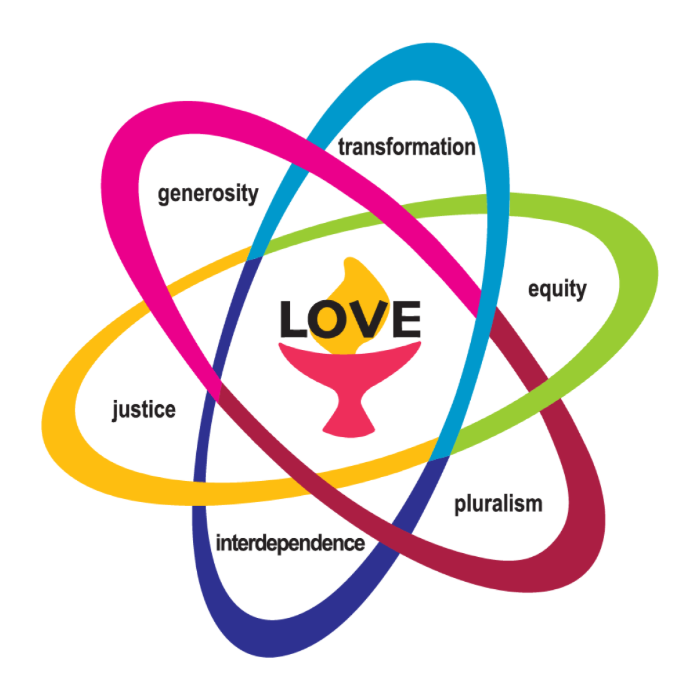
Unitarian Universalists believe more than one thing. We think for ourselves and reflect together about important topics like the existence of a Higher Power, Life and Death, Sacred Texts, Prayer and Spiritual Practices We are united in our broad and inclusive outlook, and in our shared values. We are united in shared experience: our open and stirring worship services, religious education and rites of passage; our work for justice; our commitment to center the experiences and needs of the marginalized and most vulnerable among us; our dedication to living in a way that always centers love.
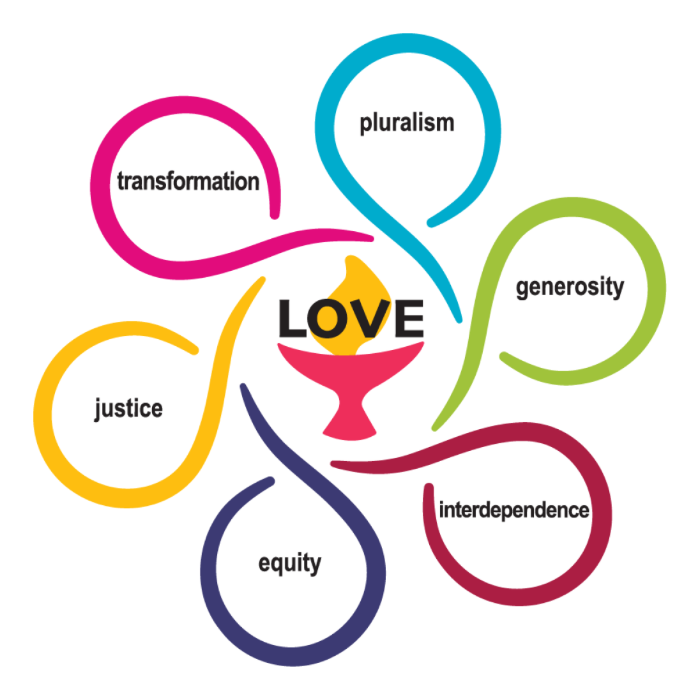
Unitarian Universalism is a living tradition that has changed in many ways from the original Christian roots of its Universalist and Unitarian heritages, and it continues to evolve today. Most recently, this evolution has taken the form of adopting new language to describe who we are as UUs. At General Assembly in June 2024, UUs voted to replace existing Seven Principles and Six Sources language in our bylaws with language describing Unitarian Universalism through these shared values, all centered around LOVE.

We honor the interdependent web of all existence and acknowledge our place in it.
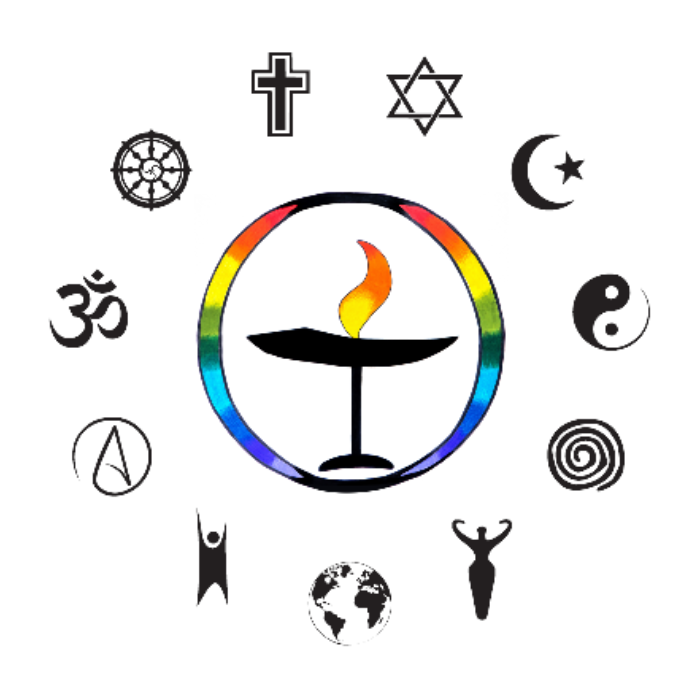
We are all sacred beings, diverse in culture, experience, and theology.
We work to be diverse multicultural Beloved Communities where all feel welcome and can thrive.
We adapt to the changing world.
We cultivate a spirit of gratitude and hope.
We declare that every person is inherently worthy and has the right to flourish with dignity, love, and compassion.
UU’s do not share one set of beliefs or teachings. Unitarian Universalism is a non-creedal faith built upon common core values and a covenant (promise) to each other based on our values. We are spiritually diverse with many different beliefs, drawing from the wisdom of many religious traditions, including humanism. Here you are invited to explore your spirituality in community.
Many Unitarian Universalists believe in God. Many do not believe in God (atheists), and many are unsure that they can know whether there is a God (agnostics). And many are interested in new metaphoric possibilities for understanding our relationship to whatever we experience as transcendent and enduring. Some embrace the language of humanist or religious naturalist as a positive reframing of their felt experiences.
Unitarian Universalists may choose their own spiritual practices and beliefs. It is important that personal beliefs be consistent with our Shared Values and the Principles of Unitarian Universalism to which we covenant (promise) as a congregation and as a larger faith tradition and association of UU congregations. (See above and below)
“Worship” comes in its root meaning from Old English and to gather in worship simply means to come together to in honor and respect of that which we find most worthy in life – we celebrate through words, rituals, and music as a way to remind and ground ourselves in what brings meaning and purpose to our individual lives and our lives in community. Everyone has a capacity to worship and to gather with others to worship regardless of their personal belief in “God.”
The UU faith tradition has long provided a framework for worship, spiritual leadership, individual beliefs, social action, religious education for youth, and moral and ethical living, which are all the hallmarks of religion. We are centuries old and represent two Christian traditions – Unitarianism and Universalism – with deep roots in Europe and which consolidated in the United States in 1961 as organized around covenants and principles and purposes. We come together with a vision to be a loving religious community where we can grow spiritually and build a more just and joyful world. We pay attention to that which is worthy, and we promise (covenant with) each other our mutual trust and support.
Because UU’s draw on the teachings of major religions, Hell is a concept of interest and debate. Hell as a potential afterlife is not taught. Instead, most UU’s tend to believe that human beings have a capacity to create hell on earth for themselves and others through their behaviors, and that is enough to recognize.
Again, because UU’s draw on the teachings of major religions, Heaven also is a concept of interest and debate. UU’s, however, strive toward heaven on earth as an ideal and their primary focus as a faith tradition. There is commitment to making our shared world better for all through our values and principles and direct actions.
Before the UU Values were adopted in 2024, UUs followed Seven (later the 8th was added) Principles. They are still a part of our beliefs today, and tie into the values of modern UUism.
The inherent worth and dignity of every person
Justice, equity, and compassion in human relations
Acceptance of one another and encouragement to spiritual growth in our congregations
A free and responsible search for truth and meaning
Respect for the interdependent web of all existence of which we are a part
The goal of world community with peace, liberty, and justice for all
The right of conscience and the use of the democratic process within our congregations and in society at large
Journeying toward spiritual wholeness by working to build a diverse multicultural Beloved Community by our actions that accountably dismantle racism and other oppressions in ourselves and our institutions